Pulao before butter chicken: What Rakesh Sharma fed Soviets in space 42 years ago
By India TodayCross-checked on TMR
Story confidence
Single source
40/100
Reported by a single source so far
The story
As Pakistan's first astronaut took butter chicken and nihari aboard China's space station, here's a look at the Indian delicacies Rakesh Sharma took to space 42 years ago. India's first man in space not only relished desi food but also shared it with his Soviet colleagues, and one particular Indian delicacy became a hit with them.
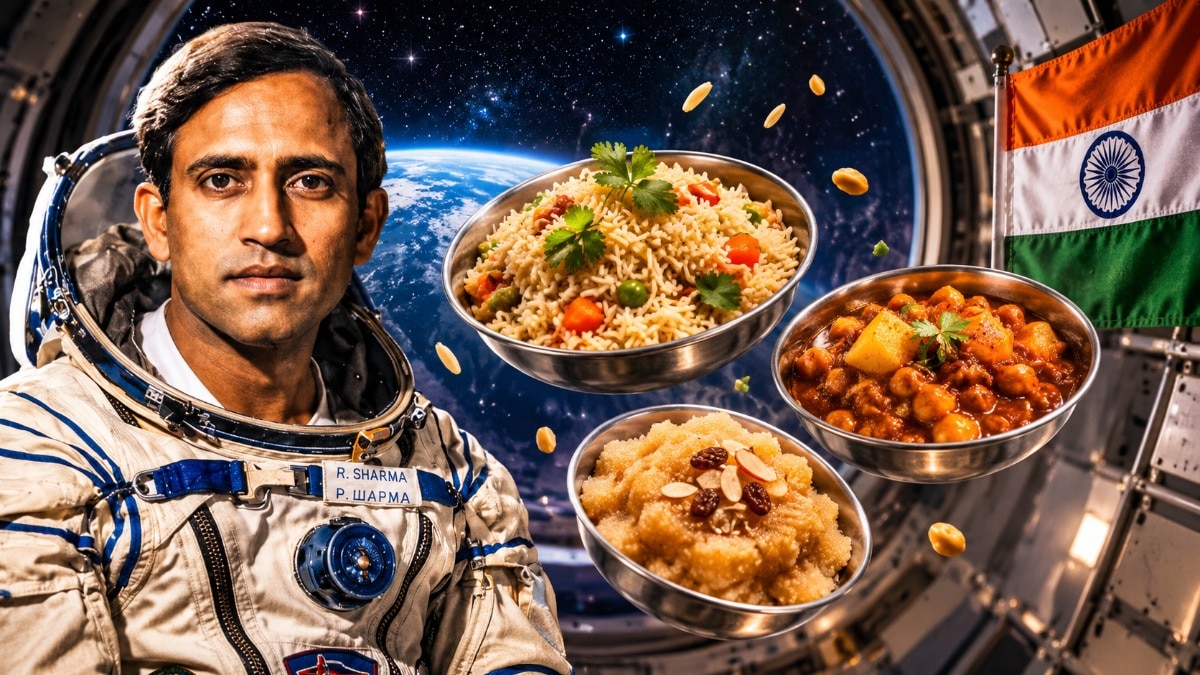
Imagine a dining table with vegetable pulao, aloo choley and sooji halwa, but even a glass of water wouldn't stay in place. Forty-two years ago, when Rakesh Sharma became the first Indian to travel to space, he took along a taste of India for his journey beyond Earth. The Indian Air Force (IAF) pilot carried specially prepared Indian delicacies aboard a Soviet space mission in April 1984. It wasn't just Sharma who got to savour Indian food in space, his Soviet colleagues got a taste of it too, according to India Today Magazine's reportage from 1984.
Cut to November 25, 2026, when Pakistan's first astronaut, Muhammad Zeeshan Ali, reached China's Tiangong space station, where a specially curated menu of over 100 halal food varieties awaited him. From beef nihari and lamb korma to choley and butter chicken, the Chinese have made elaborate arrangements to cater to the Pakistani astronaut's palate, Chinese state-run broadcaster CGTN reported.
But decades before the butter chicken made it to the Chinese space station with the Pakistani astronaut, Indian scientists had faced the challenge of sending desi food into space, and overcame it. How does one serve pulao without having grains of rice floating around a spacecraft? And how did a humble Indian mango delicacy become a hit with Soviet cosmonauts?
WHEN RAKESH SHARMA TOOK PULAO, ALOO CHOLE TO SPACE
On April 3, 1984, Squadron Leader Rakesh Sharma lifted off from the Baikonur Cosmodrome in Soviet Kazakhstan aboard the Soyuz T-11 spacecraft. Accompanying him were Soviet cosmonauts Yuri Malyshev and Gennady Strekalov.
The three were headed to the Soviet Salyut-7 orbital space station as part of the Intercosmos programme.
India Today Magazine's April 30, 1984, cover story, written by journalist Raj Chengappa, documented Sharma's life aboard the space station, including what the three cosmonauts ate.
The work compartment of the space station doubled up as the area where the cosmonauts conducted experiments, ate and slept. It was equipped with a table, a shower, toilets and sleeping arrangements.
"And for the first time, Russians ate Indian food in space brought by Sharma," India Today Magazine reported in 1984.
The dishes included vegetable pulao, aloo choley and sooji halwa. They were specially prepared by the Defence Food Research Laboratory (DFRL) in Mysore, now Mysuru.
However, the Indian delicacies did not look anything like what would be served in Indian households or restaurants. Scientists had fashioned the preparations into bite-sized rolls, individually wrapped in cellophane. The packaging helped prevent food particles from floating around in microgravity.
HOW AAM PAPAD BECAME A HIT WITH SOVIET COSMONAUTS
The preparations for Rakesh Sharma's space menu had begun in 1983, months before the actual launch.
The government had commissioned the Mysore-based laboratory to develop Indian food for the joint Indo-Soviet space mission. The scientists were given six months to accomplish the task, according to a 2012 report in Open magazine.
K Radhakrishna, then a young scientist at DFRL, was among around 100 laboratory employees involved in the exercise. Among the preparations were powdered pineapple juice, biscuits resembling cream crackers and a mango fruit bar, a variation of the aam papad relished across India.
According to the Open magazine report, only the mango bar among these preparations received the Soviet space organisation's approval.
Sharma, in an interview with the magazine in 2012, recalled how much his Soviet colleagues enjoyed the Indian delicacy.
"There, the taste buds somehow seek sharp tastes and this fit the bill well. My Russian colleagues raved about it," Sharma told Open magazine.
The cosmonauts also had access to over 80 food varieties prepared by the Soviet mission's kitchen.
Interestingly, space historians Colin Burgess and Bert Vis, in their 2016 book, 'Interkosmos: The Eastern Bloc's Early Space Programme', also mentioned fresh mangoes being sent with Sharma for the crew, according to a report in The Indian Express.
Sharma returned to Earth on April 11, 1984, after spending nearly eight days in space.
Like Rakesh Sharma in 1984, Muhammad Zeeshan Ali, too, travelled to space with two foreign colleagues, Chinese astronauts Tang Hongbo and Wu Yi. Scientists at the China Astronaut Centre studied Pakistani culinary traditions, dietary requirements and Ali's preference for spices before putting together his menu. The recipes were refined following feedback from Pakistani astronauts, while halal requirements were followed throughout the preparation and packaging process.
While technology and space food preparation have evolved considerably over the past four decades, one thing hasn't changed. Familiar flavours from home continue to be part of astronauts' belongings on journeys far away from Earth. And for Rakesh Sharma, the food he carried was more than just nourishment. It is a little piece of home, hundreds of kilometres above Earth.
Only India Today has reported this so far. New reports from every outlet are matched against it through the day.
BlindspotNo other outlet has reported this yet.
Coverage breakdown
01
Outlet
01
Report
01
Language
Coverage by language
Outlet reliability
National vs local desks
Full coverage
1 outletIndia Today · EN
Pulao before butter chicken: What Rakesh Sharma fed Soviets in space 42 years ago
Reliability unrated