Heal with the Princess of Wales: A masterclass in caring and sharing
By The IndependentCross-checked on TMR
Story confidence
Single source
40/100
Reported by a single source so far
The story
This is no conventional royal documentary about the Princess of Wales. It is something altogether more intimate: a search for her inner self, a reflection on faith and spirituality, and an eloquent expression of her love for family. At its heart is a masterclass in caring and sharing, with a message that will resonate particularly deeply with those who have experienced cancer.
What makes Heal so moving is that Catherine’s description of the walk as a “pilgrimage” is entirely apt. It is at once physical, emotional and spiritual. The Three Peaks challenge, climbing Snowdon and the other mountains over 24 hours, provides the physical framework. But the real journey of recuperation and recovery is much more profound.
We see her walking alone, absorbed in her thoughts; walking with her brother James in moments of touching closeness; and meeting fellow walkers, exchanging experiences and offering encouragement. There is a lovely reciprocity in these cancer survivor encounters. The kindness she identifies as essential to healing is something she gives back with instinctive warmth.
With James, there is an ease and intimacy, the unspoken understanding of siblings. Yet it is in her solitary moments that we perhaps see most clearly what the walk means to her. The mountains give her space to think, to breathe and to measure the distance she has travelled, not simply across the landscape but through illness and fear.
She speaks of the almost mystical significance of having her hand held when she was at her lowest point in hospital. Was it the hand of God? Was it William’s? Or was it that of a Florence Nightingale figure, one of those extraordinary nurses whose compassion can become as important as their clinical skill? The answer, she has let it be known, is an amalgam of all three.
It is an electrifying moment of television. For a few seconds, the formal constraints of royal communication fall away and we are allowed into something genuinely private: an account of vulnerability, faith and the profound human need to be held.
There is something almost stream-of-consciousness about the way she speaks. She is not delivering a polished royal message or following a carefully constructed narrative. She seems to be thinking her way through the experience, allowing emotion and memory to find their own expression. The sterility of hospital life, the feeling of being trapped in an unfamiliar and frightening world, leads her towards a discovery: that what matters most is the ability to connect.
Her strength in this film comes not from maintaining a stiff upper lip, but from being prepared to let it go. She acknowledges fear, tears, uncertainty and the need for other people. She is not trying to be anyone other than herself.
This is a watershed moment in her life, and perhaps in how we understand her.
Watch Apple TV free for 7 day
New subscribers only. £9.99/mo. after free trial.
Plan auto-renews until cancelled.
She reveals relatively little medical detail, yet opens a window into her inner life. She speaks about things that are, and always have been, matters of the heart: survival, fear, pain, love and family.
Cancer is the dark shadow throughout. She knows, as anyone who has faced it knows, that the stakes can be brutally high. She does not need to spell it out. The tension is there, in what she says and in what she leaves unsaid. She has walked a tightrope, and we begin to understand something of the precariousness of that journey.
Family is the thread running through the film. We see her walking alone, thinking of those she loves. We see her with James. And at the end comes the gathering of her children, her husband William and her parents: a cocoon of love, celebration and reassurance.
They are there to congratulate her on completing the Three Peaks challenge, but the achievement carries a much deeper meaning. It is a celebration not simply of reaching the summit, but of having made it through.
It is about family. It just happens to be the Royal Family.
There are glimpses of the person William fell in love with: the warmth, the laughter lines, the vulnerability. For a moment, the majesty falls away
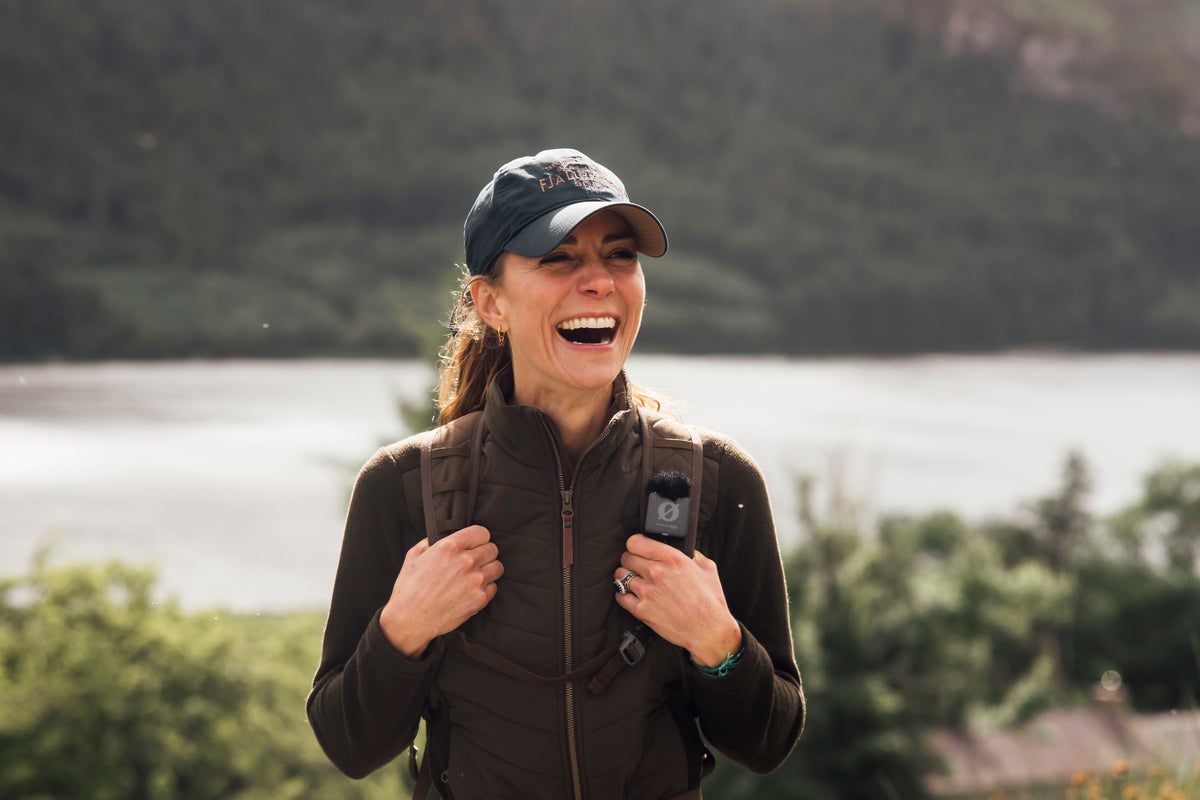
There is something particularly affecting about the contrast between the woman we see here and the public figure we know. She is not presented in the immaculate fashion silhouette of royal engagements, but wind-blown and in shorts, making her way through the mountains. There is a delicacy about her appearance, almost Bambi-like, yet also a determination to keep going.
There is not an ounce of self-pity. She has endured too much to make that her currency.
Nature is the film’s supreme co-star. The mountains and foxgloves are not merely picturesque backdrops but part of what sustains her. In the vastness and beauty of the landscape, she finds a perspective that the enclosed, clinical world of hospital treatment could never offer. Away from the demands of public life, there is space to breathe, think and perhaps begin to put herself back together.
What emerges is a woman who seems both ordinary and extraordinary. Tender, warm-hearted, capable of laughter and tears. There are glimpses of the person William fell in love with: the warmth, the laughter lines, the vulnerability. For a moment, the majesty falls away.
It is a spiritual journey as much as a physical one.
W. B. Yeats, in his poem The Gyres, urges us to “heave no sigh, let no tear drop” as he contemplates survival, history and the purpose of existence in a darkening world. But forget that. On Sunday, our nation will shed tears for and with Catherine.
In the same poem Yeats offers a more fitting conclusion elsewhere: “a greater, more gracious time has come.” There is something of that sense of arrival here. Not triumph in the conventional sense, not a victory parade, but the quiet and profound triumph of having survived.
We should not mistake this for a declaration that everything is now as it was. You go through something like this and you are never quite the same again. Cancer changes your relationship with your body, your family, your mortality and the world around you. It can humble you, but it can also reveal you.
We see that revelation here.
She has given us a glimpse of a woman changed by what she has endured. We may never see her in quite the same way again. And perhaps she does not expect us to.
At the screening, I sat directly behind her as the room broke into spontaneous, almost hushed applause. Afterwards, I turned to her.
She simply replied: “Thank you.”
While she has undoubtedly had access to the best care, that doesn’t mean she hasn’t suffered greatly. But here we find her giving back greatly too – and finding a new way to look forward.
Yeats, in his own search for hope, gives us the words:
“Out of cavern comes a voice, And all it knows is that one word — rejoice.”
Perhaps that is where Catherine has arrived. Not at the end of her journey, but at a point where she can savour the love of her family and the extraordinary gift of being here. In one of the film’s most affecting moments, she reads messages from her children, telling her how proud they are and how much they love her as she reaches the final peak.
She is not untouched by what has happened. No one could be. But there is a new understanding of what matters, and a willingness to share it.
‘Heal with the Princess of Wales’ will air on BBC iPlayer from 12pm on Sunday 29 November, and on BBC One from 6.40pm
Only The Independent has reported this so far. New reports from every outlet are matched against it through the day.
BlindspotNo other outlet has reported this yet.
Coverage breakdown
01
Outlet
01
Report
01
Language
Coverage by language
Outlet reliability
National, local and international
Full coverage
1 outletThe Independent · EN · GB
Heal with the Princess of Wales: A masterclass in caring and sharing
Reliability unrated